




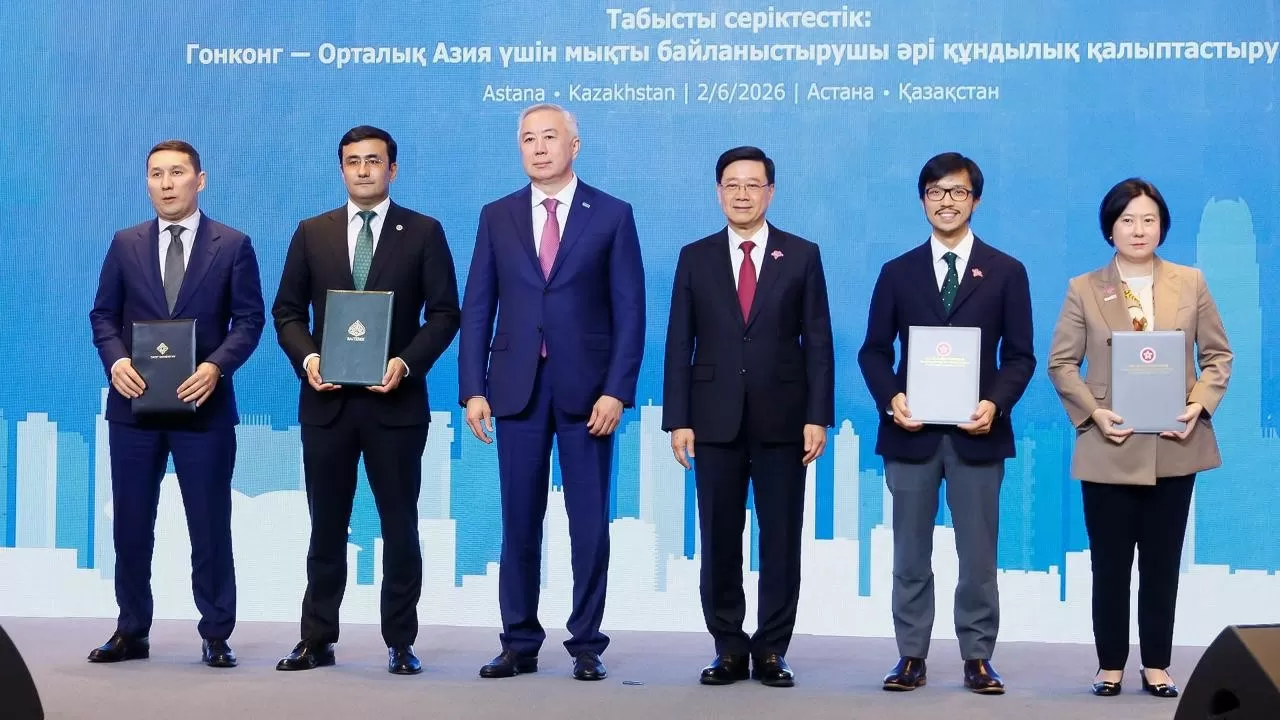
In Astana, Deputy Prime Minister – Minister of National Economy of the Republic of Kazakhstan Serik Zhumangarin held a meeting with representatives of the business communities of Hong Kong and mainland China. The event brought together around 70 business representatives, including 40 companies from Hong Kong and 30 companies from mainland China operating in finance, logistics, technology, energy, industry, and professional services.
Opening the meeting, members of the Hong Kong delegation stated that the purpose of the visit was to explore partnership opportunities between Kazakhstani companies and business entities from Hong Kong and mainland China, as well as to identify new areas for trilateral cooperation within the “Hong Kong – Mainland China – Kazakhstan” framework.
During the meeting, participants were presented with the Northern Metropolis development project. The initiative covers one-third of Hong Kong’s territory and предусматривает the creation of more than 3,000 hectares of new land, including approximately 800 hectares designated as an industrial zone. It was noted that the industrial park could serve as a gateway for Kazakhstani and Central Asian companies seeking access to the mainland Chinese market through Hong Kong as an international financial and trading hub.
Various cooperation mechanisms are being offered to investors, including public-private partnerships, joint ventures, leasing of production facilities, and co-investment opportunities. Additional advantages include a developed financial infrastructure, the application of English common law, and a comprehensive business support ecosystem.
Serik Zhumangarin noted that, thanks to its unique economic development experience, Hong Kong has become one of the world’s leading financial, trade, and logistics centers.
“We see significant potential for expanding the participation of Hong Kong partners in projects across Kazakhstan’s priority economic sectors. Kazakhstan remains a reliable and stable destination for investment, with strong creditworthiness and substantial international reserves,” the Deputy Prime Minister said.
He added that Kazakhstan’s development institutions are ready to actively attract foreign financing for major projects. In particular, the Baiterek Holding, which holds credit ratings at the sovereign level, is capable of providing up to $15–20 billion in investment financing annually and, when necessary, acting as a financial co-investor with an equity stake of up to 49% in projects.
According to Serik Zhumangarin, the development of cooperation with Hong Kong’s financial institutions and investment community is of particular interest. Promising areas include bond issuance, attracting financing in Chinese yuan, listing Kazakhstani companies on the Hong Kong Stock Exchange, and jointly implementing large-scale investment projects.
Hong Kong Chief Executive John Lee stated that the region is ready to provide Kazakhstani businesses with access to international financial markets, the infrastructure of China’s Greater Bay Area, and the opportunities offered by the Northern Metropolis, a new center for innovation, science, and technology.
One successful example of cooperation is the issuance of Chinese yuan-denominated Eurobonds by the Development Bank of Kazakhstan, listed on both the Hong Kong and Kazakhstan stock exchanges.
Another practical instrument under consideration is the Adal Fund L.P., with a target size of up to $1 billion, aimed at developing export-oriented agriculture, deep processing of agricultural products, and consolidating domestic producers.
“Over the past 20 years, Kazakhstan has attracted more than $445 billion in foreign direct investment, including approximately $30 billion from China. Investment from Hong Kong into Kazakhstan’s economy has reached nearly $740 million. We are interested in further strengthening our partnership and creating new investment opportunities for businesses in our countries,” Serik Zhumangarin said.
Frederick Ma, Chairman of the Hong Kong Trade Development Council (HKTDC), emphasized that the delegation brought together leading business representatives from Hong Kong and mainland China who are ready to implement joint projects with Kazakhstani partners.
According to him, the Hong Kong Trade Development Council has been promoting international trade relations for 60 years and today operates a network of 51 offices worldwide, including a representative office in Almaty. The office supports both Hong Kong investors entering the Kazakhstani market and Kazakhstani companies seeking to expand their presence in Asia.
As a result of the business delegation’s visit, 4 intergovernmental memorandums of understanding and 42 agreements and memorandums were signed between companies and organizations from Kazakhstan, Hong Kong, and mainland China. The documents cover cooperation in aviation, finance, trade, innovation, technology, the digital economy, and green development.


